Most guides to the 4Cs explain what each one is. That’s useful. What they rarely explain is what to do with them: which Cs to prioritize, where budget is best applied, and why the right answer for one buyer is the wrong answer for another depending on their metal, setting style, and what they actually care about.
The Gemological Institute of America developed the 4Cs system in the 1950s to standardize how diamonds are described and compared. Before GIA, diamond quality was assessed subjectively, often inconsistently, and with no shared language between sellers and buyers. The 4Cs changed that. Today, diamonds sold with credible third-party grading reports are described using the same four criteria, with GIA and IGI being the most widely recognized labs among consumers.
This guide approaches the 4Cs from the perspective of designing a custom piece: not which diamond to pick from a case, but how each grading criterion interacts with your setting design, metal choice, and budget — and where the tradeoffs actually live.
Key Takeaways
- Cut is the one place you should not compromise, as it determines light performance. Round diamonds are graded by GIA and IGI (Excellent or Ideal as the highest grades), while fancy shapes are evaluated using IGI cut grades or GIA-reported proportions, symmetry, and light performance.
For Natural Diamonds
- G–H color is the practical sweet spot for most buyers in white gold. In yellow or rose gold, I–J works without visible difference.
- Eye-clean, not VVS, is the clarity standard that matters for daily wear. VS2 and many SI1 brilliant-cut stones qualify. Step cuts (emerald, Asscher) need stricter clarity review.
- Diamond shape changes how all four Cs perform. Elongated shapes appear larger per carat; step cuts reveal inclusions and color more readily than brilliant cuts.
- Carat is weight, not quality. Buying just under a round carat size delivers near-identical visual size often with a meaningful price difference.
For Lab Diamonds
- D–F color is highly attainable and often worth it. Because lab diamonds are significantly more affordable, many buyers can access truly colorless stones without stretching budget. G–H is still a strong value option if prioritizing size.
- VS1–VVS clarity is more common, but still prioritize eye-clean. Lab diamonds tend to skew higher clarity, but the same rule applies: what matters is how it looks to the eye. Avoid paying a premium for VVS unless it’s meaningful for the specific shape.
- Diamond shape still changes how the 4Cs perform. Step cuts (emerald, Asscher) show inclusions and color more easily, so higher clarity and color grades are worth considering. Brilliant cuts (round, oval, cushion) are more forgiving.
- Carat becomes a design decision, not a tradeoff. With lab pricing, buyers can prioritize size, proportions, and overall look rather than compromising across the 4Cs. Focus on balance and finger coverage rather than chasing arbitrary weight milestones.
Cut: The C That Controls Everything You Actually See
GIA assigns a formal cut grade only to round brilliant diamonds while IGI does apply cut grades to all shapes. With fancy shapes, the GIA evaluates cut quality by assessing the stone’s proportions, symmetry, and how it performs under different lighting conditions.
Cut is what determines how much light a diamond captures, bends, and returns to your eye. It is graded on the diamond’s proportions, symmetry, and polish — how precisely each facet was shaped and aligned during cutting. A diamond with ideal proportions reflects light back through the crown cleanly, producing brightness (white light), fire (colored flashes), and scintillation (the sparkle pattern when the stone moves). Poor proportions cause light to leak out the bottom or sides, resulting in a diamond that looks dull.
Proportions are evaluated based on the following:
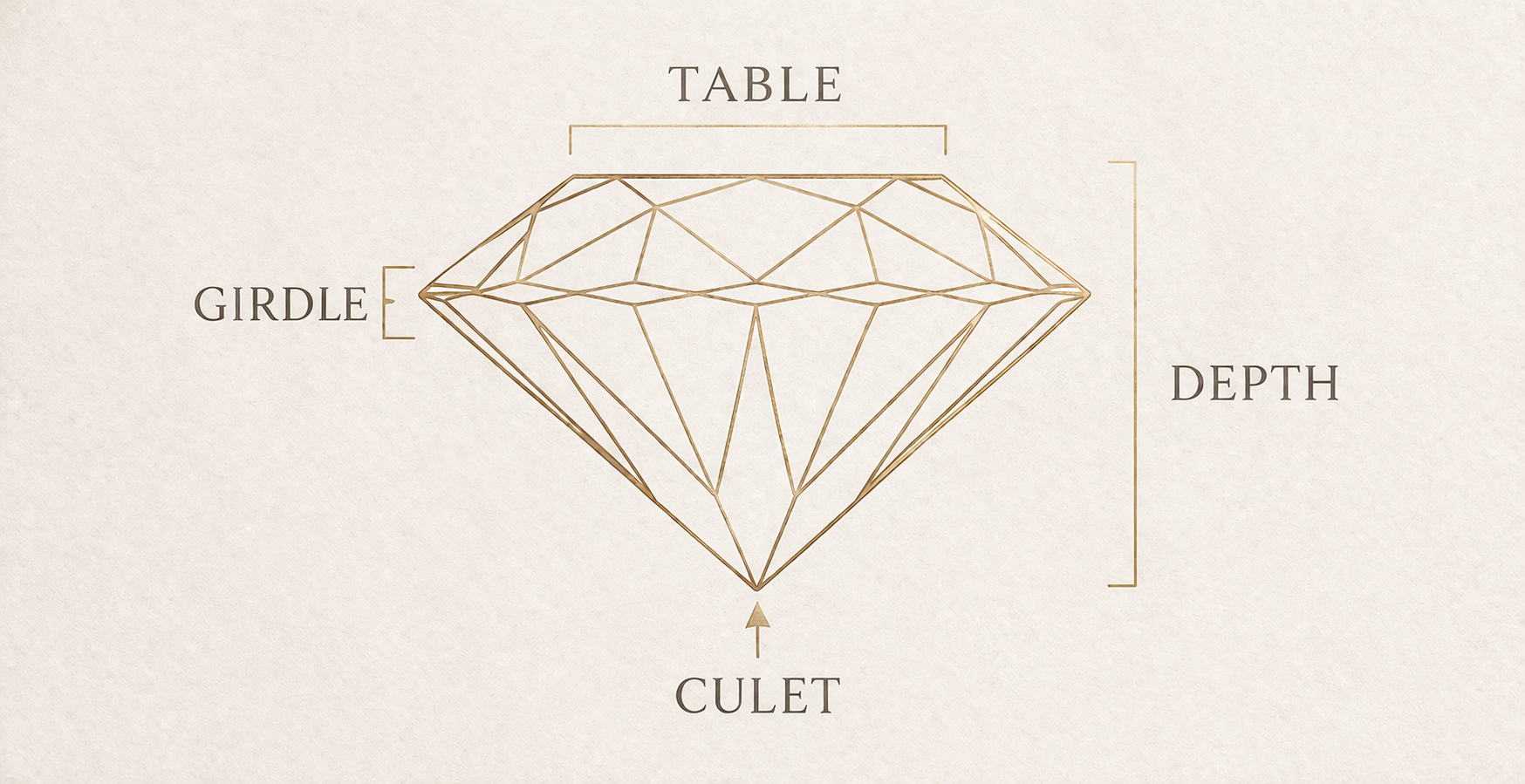
Depth: The total height of the diamond, measured from the top surface down to the tip. Depth plays a major role in light performance — too shallow or too deep, and light can escape instead of reflecting back to the eye.
Table: The flat surface at the very top of the diamond and its largest facet. This is the primary entry point for light, so its size impacts both brightness and fire.
Girdle: The outer edge that defines the diamond’s perimeter. Girdle thickness matters for both durability and proportions — too thin can risk chipping, while too thick can add unnecessary weight without improving appearance.
Culet: The small point or facet at the very bottom of the diamond. In most well-cut modern stones, the culet is either very small or not visible, ensuring it doesn’t interrupt light return.
How those proportions are cut determines three visible qualities: brilliance (white light returned through the crown), fire (colored flashes as light disperses into its spectrum), and scintillation (the sparkle pattern as the stone moves). A poorly cut stone may look bright under a direct spotlight but goes flat in normal light — because light leaks out the bottom or sides instead of returning to your eye.
The GIA cut scale for round brilliants runs: Excellent, Very Good, Good, Fair, Poor. IGI runs Ideal, Excellent, Very Good, Good, Fair. In practice, Excellent and Ideal represent the same standard — the top tier of light performance.
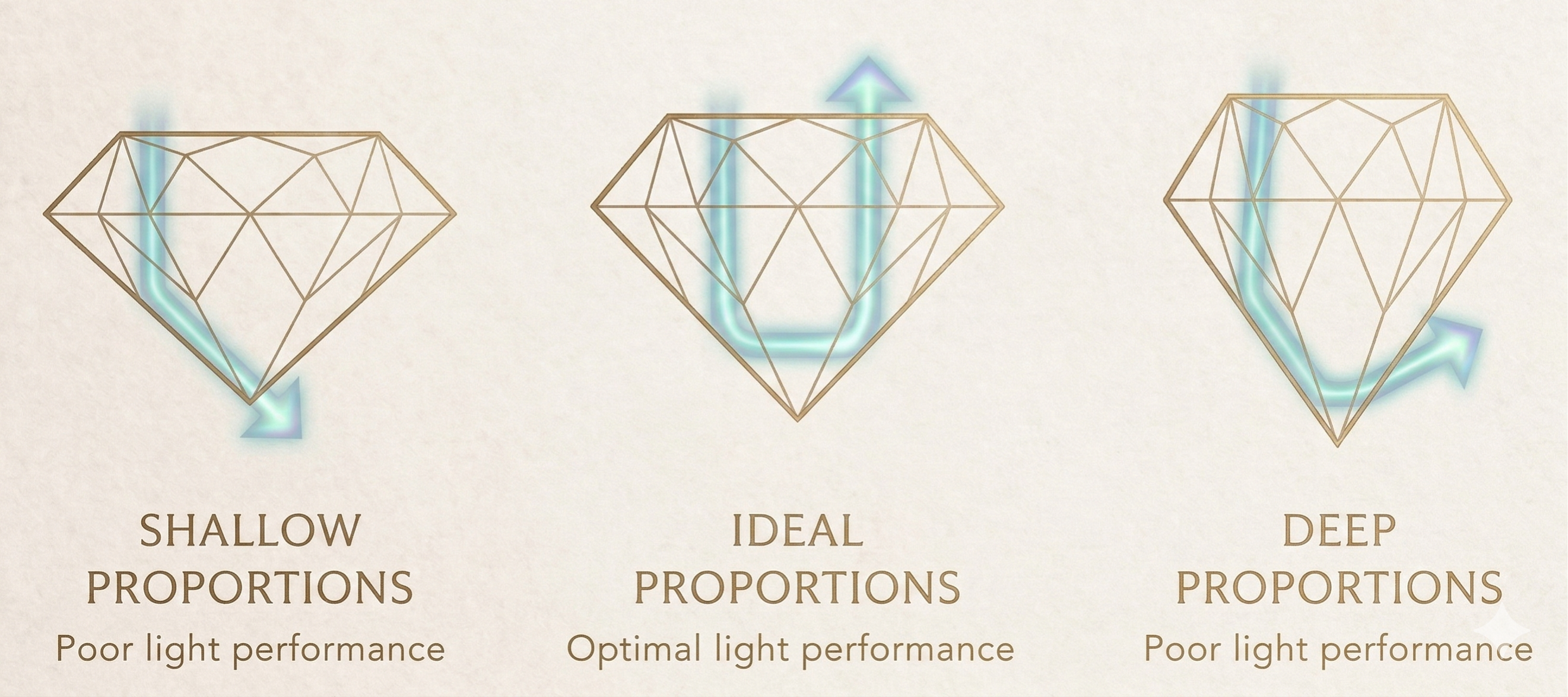
Why cut quality should not be traded away
A well-cut diamond in a lower color or clarity grade will consistently outperform a poorly cut diamond with superior grades in either category. Cut is the multiplier that makes every other quality visible. A dull, heavy-cut stone looks flat regardless of how colorless or internally clean it is. An Excellent-cut stone in an H color makes the most of every photon that enters it. For round brilliants, Excellent (GIA) or Ideal (IGI) is the standard — both represent the top tier of light performance. Very Good is often acceptable and can represent strong value when proportions are tight to Excellent. Good and below should generally be avoided for center stones.
For fancy shapes, GIA reports proportions and symmetry but does not assign a formal cut grade. IGI does issue cut grades for popular fancy shapes. In both cases, we evaluate the stone through its reported proportions, symmetry grade, polish, and how it performs under different lighting conditions — the grade on the report is a starting point, not the full picture.
- Round brilliants — GIA: Formal cut grade on every report — Excellent, Very Good, Good, Fair, Poor. Excellent is the target.
- Round brilliants — IGI: Formal cut grade on every report — Ideal, Excellent, Very Good, Good, Fair. Ideal or Excellent is the target.
- Fancy shapes — GIA: No formal cut grade; evaluate via proportions, symmetry, and polish reported on the certificate, plus light performance under different lighting conditions.
- Fancy shapes — IGI: Cut grade assigned for popular fancy shapes; use it as a guide alongside proportions and careful evaluation of symmetry and polish.
- Where we draw the line: Stick to Ideal or Excellent cut diamonds to preserve light performance since it isn’t a trade-off worth making.
Color: The C That Interacts With Your Metal Choice
Yes. G falls in the near-colorless range on the GIA scale and is effectively indistinguishable from colorless grades to the unaided eye in most settings. It is one of the most popular color grades for engagement rings for exactly this reason. It has strong optical performance at a meaningful price difference from the D–F colorless tier. For lab diamonds, however, the smaller price gap often makes D–F color a much more accessible upgrade, so buyers often choose to go fully colorless without a significant tradeoff.
Diamond color is graded on a scale from D (colorless) to Z (light yellow), developed by GIA to describe the presence or absence of yellow or brown tones in a white diamond. The scale starts at D because previous systems had already used A, B, and C so the GIA chose to start fresh. The differences between adjacent grades are subtle enough that distinguishing them requires comparing stones face-down on a white surface under controlled lighting; most buyers cannot reliably separate neighboring grades in a ring setting.
The grades in practice (natural and lab-grown diamonds)
The GIA color scale applies consistently to both natural and lab-grown diamonds, so these ranges hold true across both. The difference is in pricing dynamics — premiums are steep in natural diamonds and much less pronounced in lab-grown.
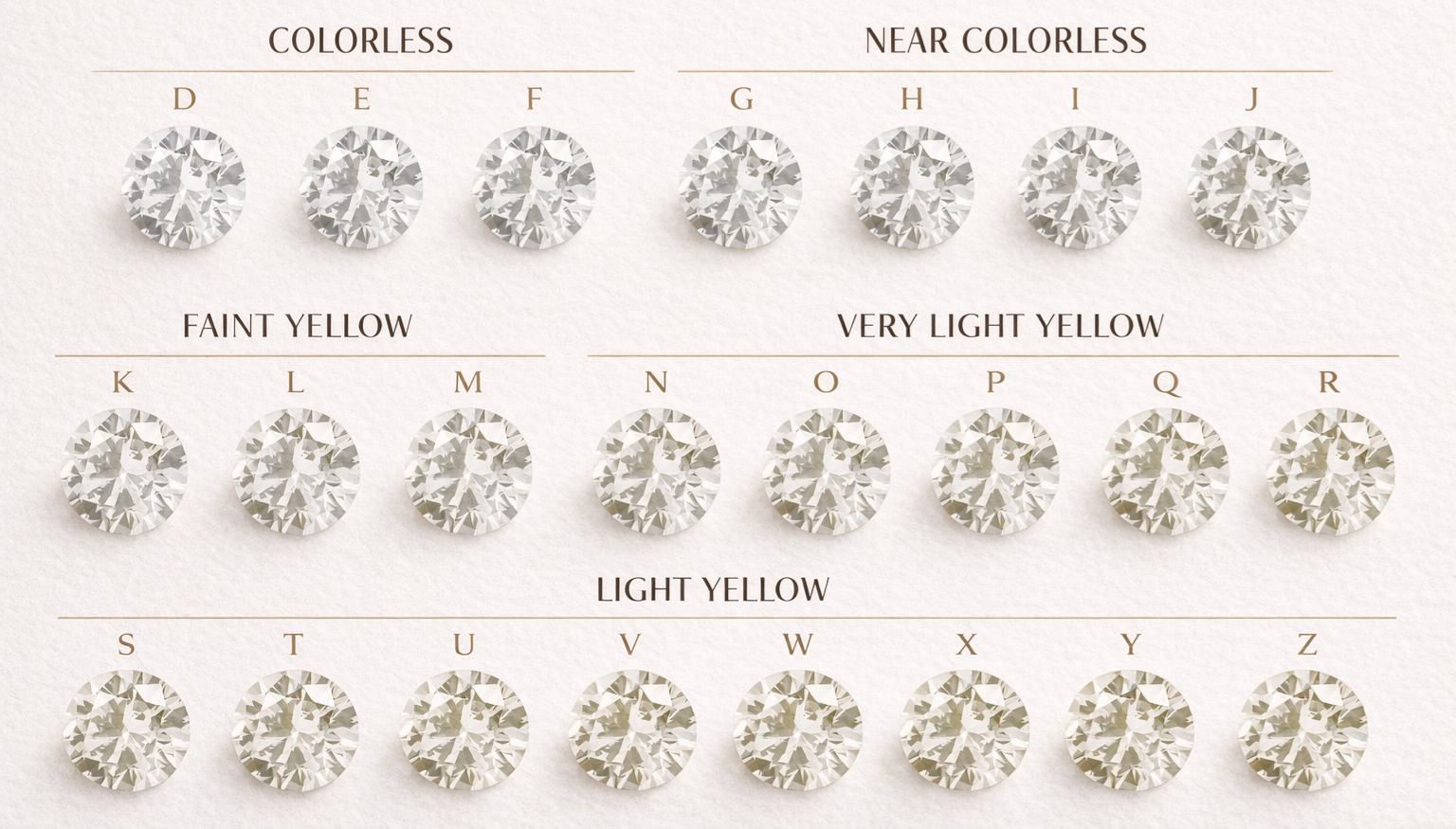
D–F (colorless): The top tier. Truly colorless under magnification and to the eye. In natural diamonds, these grades carry a significant premium over near-colorless. In lab diamonds, they are far more accessible, which is why many buyers opt for D–F without a major cost tradeoff. Best paired with white gold or platinum to preserve the stone’s neutrality.
G–H (near-colorless): The practical sweet spot, especially for natural diamonds. Both appear white in normal viewing conditions and pair well with any metal. The price difference versus D–F is meaningful in natural stones but much smaller in lab diamonds, where visual differences remain minimal.
I–J (near-colorless, slightly warmer): A slight warmth can be detected in side-by-side comparisons with higher grades, but in isolation they still read as white to most eyes. In yellow or rose gold, the warmth complements the metal. This range is more commonly selected in natural diamonds; in lab diamonds, many buyers move higher in color given the relatively small price differences.
K and below: A visible warmth that is noticeable in most settings. Yellow gold can absorb and complement this tone, making it feel intentional. Below K, color becomes increasingly apparent regardless of metal. This range is more typical in natural diamonds, as lab-grown buyers often opt for higher color grades due to limited incremental cost.
Colored diamonds: Diamonds can occur in a wide range of colors, from rare hues like red, blue, and green to more common tones like yellow and brown. These fancy color diamonds are graded based on color intensity rather than the D–Z scale, with grades ranging from Faint through Fancy Vivid, Fancy Dark, and Fancy Deep. In natural diamonds, value is driven by both rarity and intensity, with highly saturated colors often commanding prices above comparable white diamonds, while more common hues like yellow or brown may be less expensive depending on intensity. Lab-grown diamonds follow the same grading system but are priced significantly lower overall; while some colors require more complex growth or treatment processes, even highly saturated lab colors are generally far more accessible than their natural counterparts.
How your metal choice changes the calculus
Yellow and rose gold reflect warmth into any diamond set in them, while white gold and platinum preserve a cooler, more neutral appearance. This means a diamond may appear slightly warmer in yellow or rose gold and cooler in white metals. In practice, warmer metal tones can accommodate slightly lower color grades without a noticeable visual impact, while white metals tend to highlight color more, making higher color grades preferable for a crisp, colorless look. (For a deeper look at how the metals compare, see our guides to white gold vs. yellow gold vs. rose gold and what karat gold is best.)
One additional variable worth knowing: Some diamonds exhibit fluorescence, which is a glow under ultraviolet light, most commonly blue. In near-colorless diamonds (G–J), faint to medium blue fluorescence is generally neutral to positive, and stronger fluorescence can make the stone appear slightly whiter by offsetting natural warmth. In higher color grades (D–F), strong fluorescence is usually less desirable because it can sometimes create a hazy or milky appearance in certain lighting conditions.
How carat and shape play with color
Size and shape also impact how color is perceived. Larger diamonds tend to show color more, all else equal. For example, a 3-carat K color diamond will appear noticeably warmer than a 1-carat K of the same grade. Shape plays a similar role. Brilliant cuts with many facets tend to mask color, while step cuts such as emerald or Asscher cuts, with larger open facets, make color more apparent.
- Scale: D (colorless) through Z (light yellow)
- Sweet spot: For natural diamonds, G–H for white gold; I–J acceptable in yellow or rose gold. For lab diamonds, D–F is often attainable, with G–H still a strong value option if prioritizing size.
- Colorless tier (D–F): Premium exists for natural stones with minimal visible difference for most buyers. In lab diamonds, the premium is smaller, so going colorless is often a practical upgrade.
- Fluorescence: Faint to medium blue can be neutral or positive in G–J stones; strong blue is generally avoided in D–F (applies to both, though more relevant in natural diamonds).
- Tradeability: High — especially when metal choice is warm, with much more pricing flexibility in lab due to lower overall cost
Clarity: The Most Misunderstood C
Eye-clean describes a diamond whose inclusions and blemishes are not visible to the unaided eye under normal viewing conditions — no loupe, no magnification. It is the practical standard that matters for daily wear. The GIA & IGI clarity grades are measured under 10x magnification, which reveals far more than any observer ever sees. An eye-clean SI1 diamond and a VVS2 diamond are indistinguishable in a ring on a hand.
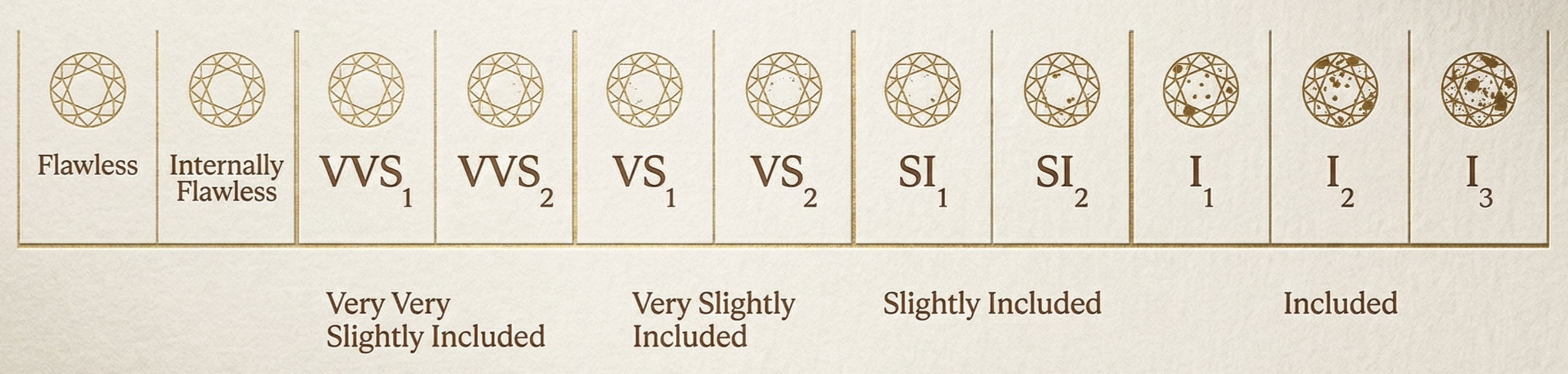
Clarity refers to the presence of internal inclusions and external blemishes formed during a diamond’s growth. Inclusions can include crystals, clouds, or feathers, while blemishes exist on the surface. These characteristics can affect how light passes through the diamond and influence value. In general, fewer or less visible inclusions result in higher clarity grades and higher prices. The GIA / IGI clarity scale grades diamonds based on the size, type, location, and visibility of these features under 10x magnification:
- Flawless (FL) – No inclusions and no blemishes visible.
- Internally Flawless (IF) – No inclusions visible but does have blemishes.
- Very, Very Slightly Included (VVS1 and VVS2) – Inclusions so slight they are difficult for a skilled grader to detect even under magnification.
- Very Slightly Included (VS1 and VS2) – Inclusions are observed with effort but can be characterized as minor.
- Slightly Included (SI1 and SI2) – Inclusions are noticeable.
- Included (I1, I2, and I3) – Inclusions are obvious which may affect transparency, brilliance and durability.
Flawless diamonds are extremely rare, representing roughly 0.5–1% of all diamonds, and the grading standard itself is far more stringent than what is visible in normal wear.
In practice, most inclusions in VS2 diamonds and many in SI1 diamonds are not visible to the naked eye. This is the most important concept to understand. Clarity grading reflects microscopic differences that often do not impact how a diamond looks in real-world settings. Moving from VS2 to higher grades such as VVS typically means paying for differences visible under magnification, not to the unaided eye. This tradeoff is more pronounced in natural diamonds, where higher clarity grades carry meaningful premiums. In lab-grown diamonds, the price difference between these grades is typically much smaller, which is why higher clarity is more commonly selected.
These principles apply equally to natural and lab-grown diamonds, as both are graded on the same clarity scale. One note worth knowing: some diamonds undergo clarity treatments — laser drilling or fracture filling — which reduce value and must be disclosed on the certificate. GIA and IGI reports will flag these; it’s another reason to only buy with a cert from one of those two labs.
Shape affects how visible inclusions are
Not all diamond shapes handle inclusions the same way. Brilliant cuts — round, oval, pear, cushion — scatter light through many small facets, which obscures inclusions effectively. An SI1 round brilliant is eye-clean in the vast majority of cases. Step cuts — emerald cut and Asscher — have large, open facets arranged in parallel rows, creating a “hall of mirrors” effect. These cuts are beautiful but transparent: inclusions are far more visible in step cuts than in brilliant cuts. For an emerald cut, VS2 or VS1 is a more conservative floor; SI1 requires careful review of the certificate.
Setting style also matters
A bezel setting wraps a metal collar around the diamond’s girdle, covering the outer edges of the stone. Inclusions that sit near the girdle — the most common location — may be hidden entirely by the bezel. A prong setting exposes the entire crown and much of the girdle. This means that with a bezel or channel setting, your practical clarity floor can be lower; with an open prong setting, you want to be more careful about inclusions near the girdle.
Where the floor genuinely sits: I1 and below should generally be avoided for center stones. At these grades, inclusions are large enough to be visible to the naked eye without effort, and in some cases may impact durability. For most buyers, VS2 to eye-clean SI1 represents the practical range, where inclusions are not visible in normal viewing. In lab-grown diamonds, higher clarity grades such as VS and VVS are more commonly produced and come with a relatively small price increase, so it is often reasonable to select a higher clarity without a meaningful tradeoff.
- Scale: FL → IF → VVS1/VVS2 → VS1/VS2 → SI1/SI2 → I1/I2/I3
- Practical standard: Eye-clean — inclusions not visible without magnification
- Brilliant cuts (round, oval, pear): SI1 is often eye-clean; VS2 provides added comfort
- Step cuts (emerald, Asscher): VS1–VS2 is a more reliable floor; SI1 requires careful certificate review
- Setting interaction: Bezel settings hide girdle inclusions; prong settings expose them
- Hard floor: Avoid I1 and below for center stones — inclusions visible to the naked eye and may affect durability
- Lab-grown note: VS and VVS grades are more commonly produced in lab diamonds and come with a relatively small price premium — often worth selecting
- Tradeability: High — the C most buyers overpay on relative to visible impact
Carat: Weight, Not Quality
Visually, no — not in any meaningful way. A 0.90-carat round brilliant measures approximately 6.3mm in diameter; a 1.00-carat measures approximately 6.5mm (exact dimensions vary slightly with cut proportions). That difference is roughly 0.2mm — imperceptible in a ring setting. The price difference, however, is significant because of how demand clusters around round-number thresholds.
Carat is a unit of weight. One carat equals 0.2 grams. A half-carat diamond may be referred to as a 50-point stone. It correlates with size — heavier diamonds are generally larger — but the relationship between carat and visible size depends heavily on cut quality and diamond shape. A well-cut stone carries its weight efficiently in the crown (the top face of the diamond, which is what you see in a setting). A poorly cut stone may appear smaller than its carat weight because too much mass is concentrated in the depth.

Sizes and price
Diamond prices are not linear per carat. As size increases, diamonds become increasingly rare, so a 2-carat stone costs significantly more than twice a 1-carat stone of the same quality. Prices also step up at milestone weights — 0.50ct, 1.00ct, 1.50ct, and 2.00ct — due to concentrated buyer demand at those thresholds. A 0.95ct diamond is visually indistinguishable from a 1.00ct stone but can cost meaningfully less. Buying just under these thresholds is a reliable way to optimize value without any visible sacrifice. These dynamics are most pronounced in natural diamonds. Lab-grown diamonds follow the same pattern but at a much lower price point, with the gap widening significantly at larger carat sizes.
Shape and face-up size
Different shapes distribute the same carat weight differently across the face-up area. Elongated shapes — oval, pear, marquise — spread weight across a larger surface, making them appear larger per carat than round brilliants. An oval diamond at 1.00ct typically has a face-up area that reads closer to a 1.15–1.20ct round brilliant. Round brilliants are the most compact shape for a given carat weight. If face-up size matters and budget is a constraint, elongated shapes offer meaningful visual return per carat.
- Unit: Weight (1 carat = 0.2 grams)
- Size correlation: General, but shaped by cut quality and diamond shape
- Magic sizes: Price premiums at 0.50, 1.00, 1.50, 2.00ct — buying just under each saves meaningfully
- Face-up efficiency: Oval, pear, and marquise appear larger per carat than round brilliant
- What it’s not: Carat is not a quality metric — it measures size preference, not optical performance
- Tradeability: High — adjust carat to taste once cut, color, and clarity are set
How to Choose When You Can’t Max Out Every C
Most buyers are working within a budget. The question is not how to choose a perfect diamond; it is how to choose the right diamond for what you care about most. Here is how to prioritize when something has to give.
1. Protect cut first. Stick to Excellent or Ideal. Cut is the only C you can’t fix later and has the biggest impact on how a diamond performs.
2. Set a clarity floor, then stop. For most brilliant cuts, VS2 or eye-clean SI1 is sufficient; for step cuts, lean VS2 and evaluate more closely. In natural diamonds, going higher carries real cost with little visible benefit. In lab diamonds, higher clarity (VS–VVS) is more accessible, so moving up is often reasonable.
3. Adjust color to the setting. In white metals, stay around G–H. In yellow or rose gold, G–J works well. In natural diamonds, dropping a grade can meaningfully reduce price; in lab diamonds, many choose higher color given the smaller price gaps.
4. Use the rest on size. Buy just under key thresholds (e.g., 0.95 vs 1.00). If size is the priority, lab diamonds make larger carat weights significantly more attainable.
What to prioritize — natural vs. lab-grown
| Natural Diamond | Lab-Grown Diamond | |||
|---|---|---|---|---|
| Where to focus | Where to save | Where to focus | Where to save | |
| Cut | Excellent or Ideal — no exceptions | Nothing; cut is non-negotiable | Excellent or Ideal — no exceptions | Nothing; cut is non-negotiable |
| Color | G–H in white metals; G–J in warm metals | Dropping a grade saves meaningfully; metal absorbs warmth | D–F often accessible; G–H still solid | Smaller price gaps mean less pressure to drop grades |
| Clarity | VS2 or eye-clean SI1 for brilliants; VS2 for step cuts | Going above VS2 in a brilliant cut pays for microscope differences | VS–VVS more accessible; moving up is often reasonable | Eye-clean SI1 still sufficient if budget is the priority |
| Carat | Buy just under key thresholds; elongated shapes maximize face-up | 0.95ct vs 1.00ct is visually identical, meaningfully cheaper | Lab pricing makes larger sizes significantly more attainable | Less pressure to buy under thresholds; gaps are smaller |
| Overall | Cut first; trade color and clarity to free budget for carat | Color and clarity are the most tradeable Cs | Cut and color first; savings flow into carat | Clarity is the most tradeable C at lab-grown prices |
A diamond’s 4C grades are only as meaningful as the lab that issued them. Without a certificate from a credible grading lab, the grades are the seller’s own assessment — not an independent one. The two grading bodies that meet the standard for most buyers are GIA (Gemological Institute of America) and IGI (International Gemological Institute). GIA is the most conservative and widely cited standard; its grades are trusted universally and tend to be slightly stricter than IGI for natural diamonds. IGI grades extensively for lab-grown diamonds and is the standard most commonly seen on lab-grown certificates. Both are credible. Other labs — including EGL and some house labs used by retailers — have documented grade inflation; a stone graded VS1 by EGL may not reach VS1 by GIA standards. Only buy diamonds with GIA or IGI certificates.
The 4Cs in a Custom Piece
Designing a custom piece changes the 4Cs decision in one meaningful way: you are choosing a stone and a setting simultaneously. In a retail environment, you choose from what’s in a case. Designing custom means the two inform each other — the setting design can be adjusted around the stone’s specific characteristics.
A bezel setting around a stone with a girdle inclusion can hide that inclusion entirely. A side-stone design can draw visual attention away from the center stone’s slight warmth in color. Prong height and number affect how much of the girdle is exposed. These details are available when designing from scratch; they’re not a variable when buying from inventory.
From our experience designing custom pieces
At Kalakari, we work with both natural and lab-grown diamonds, all GIA or IGI certified. Most of our clients start a custom engagement ring conversation focused on carat — and through the process, many shift budget toward cut quality once they understand how much it drives the stone’s visual impact. Once you compare an Excellent-cut stone to a Good-cut stone of the same carat weight on paper, the decision tends to settle quickly.
Clients designing in yellow gold regularly find that H–I color and eye-clean SI1 clarity look identical in the finished piece to what they imagined at G and VS2 — and the freed budget often goes toward a slightly larger stone or a more detailed design. That trade is hard to see on paper but easy to see in the final result.
- Lab-grown clients: Tend to prioritize cut and color heavily, then allocate the price savings from lab-grown into carat
- Natural diamond clients: Often focus on the G–H color range; many end up closer to H or I once they understand how metal tone interacts with the stone
- Oval and elongated shapes: Consistently popular; clients often move to oval after learning how face-up size compares to round at the same carat weight
If you’re ready to talk through stone selection for a custom piece, reach out to start a conversation. We walk through each of these decisions together before any stone is sourced.
Frequently Asked Questions
The 4Cs are the four criteria used to grade a diamond’s quality: cut (how well the diamond is faceted and proportioned), color (how colorless or warm the stone appears), clarity (how free the stone is from internal inclusions and surface blemishes), and carat (the stone’s weight). The system was developed by the Gemological Institute of America (GIA) in the 1950s and is now the universal standard for describing and comparing diamonds worldwide.
Cut matters most, and by a meaningful margin. A poorly cut diamond looks dull regardless of its color or clarity grade; an excellent-cut stone in a lower color or clarity grade can outshine a worse-cut stone with superior grades in either category. Color and clarity interact with each other and with your metal and setting choices, so they involve real tradeoffs. Carat is a preference — it reflects size, not quality.
For most buyers, G or H is the sweet spot. Both fall in the near-colorless range on the GIA scale and appear white to the unaided eye in normal viewing conditions. The savings versus colorless grades (D–F) are significant, with no visible difference in most settings. If you’re setting the diamond in yellow or rose gold, you can safely go to I or even J — the warm metal absorbs the stone’s slight warmth rather than contrasting it.
Eye-clean describes a diamond whose inclusions are not visible to the unaided eye under normal viewing conditions — no loupe, no magnification, no searching. It’s the practical standard that matters for daily wear. Most VS2 diamonds are eye-clean, and many SI1 diamonds are as well, depending on the type and location of the inclusion. The GIA clarity grade measures what’s visible under 10x magnification, which is far more rigorous than what’s visible in real life. An eye-clean SI1 is indistinguishable from a VVS stone when worn.
Yes, identically. Lab-grown diamonds are graded on the same cut, color, clarity, and carat scale by GIA and IGI using the same criteria as natural diamonds. Optically, chemically, and physically, a lab-grown diamond is the same material as a mined diamond. The difference is origin, not quality criteria. IGI is the most widely used grading lab for lab-grown diamonds; GIA also grades lab-grown stones and recently began issuing full grading reports for them.
GIA (Gemological Institute of America) is the most conservative and globally recognized diamond grading standard. IGI (International Gemological Institute) grades both natural and lab-grown diamonds and is widely used for lab-grown stones. For natural diamonds, GIA grades tend to be slightly stricter than IGI; a stone graded VS1 by IGI might receive a VS2 from GIA. For lab-grown diamonds, IGI is generally considered the standard. Both are credible; neither should be confused with lesser labs like EGL, whose grade inflation is well-documented in the industry.
Shape changes how all four Cs perform. Round brilliants have a formal GIA cut grade and scatter light in a way that masks inclusions effectively — an eye-clean SI1 is common. Elongated brilliant shapes (oval, pear, marquise) appear larger per carat than rounds and also hide inclusions well, but have no formal cut grade, so proportions must be evaluated directly. Step cuts (emerald, Asscher) have large open facets that reveal inclusions and color more readily than any brilliant cut — they require stricter clarity review and tighter color grades. Choosing shape and grades together produces a better outcome than setting grades first and choosing shape after.
Yes — VS2 is an excellent clarity choice for most buyers and the practical sweet spot for brilliant-cut diamonds. At VS2, inclusions are minor and require effort to detect even under 10x magnification; they are invisible to the naked eye in virtually every case. For step cuts like emerald and Asscher, VS2 is the recommended minimum due to those shapes’ open facets. For most brilliant cuts (round, oval, pear, cushion), eye-clean SI1 is also a strong option and can free meaningful budget for cut or carat quality.
Protect cut quality first — it cannot be compensated for by any other choice. Then set a clarity floor based on your shape: eye-clean SI1 to VS2 for brilliant cuts, VS2 for step cuts. Adjust color based on metal: G–H for white gold, G–J for yellow or rose gold. Use what remains on carat and shape, buying just under magic-size thresholds (0.90ct instead of 1.00ct, for example) and considering an elongated shape if face-up size matters. The combination of yellow gold, oval shape, H–I color, and eye-clean SI1 is one of the most value-efficient builds for a custom engagement ring.