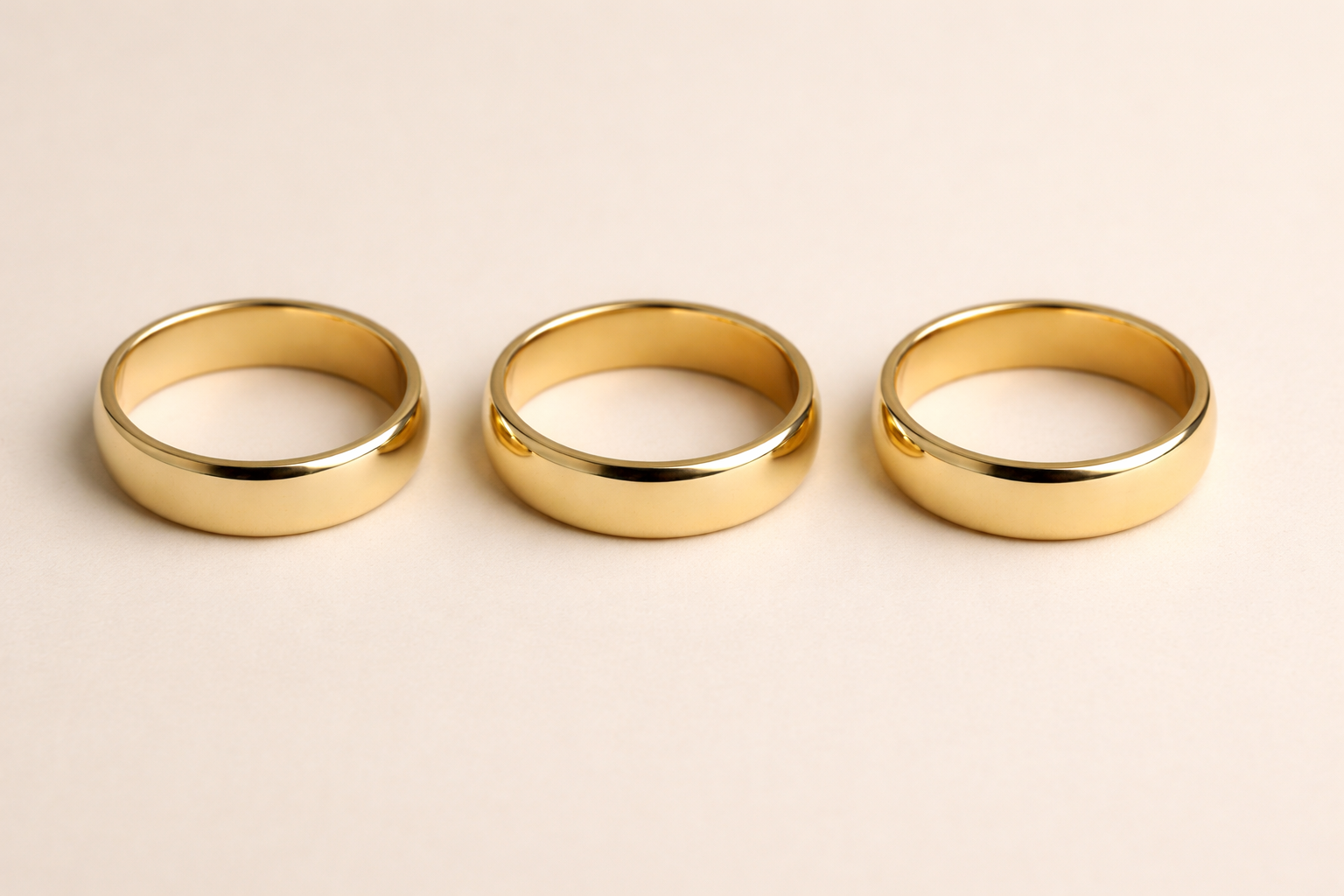
If you've spent any time shopping for jewelry, you've seen numbers stamped inside rings and on the clasps of chains: 10k, 14k, 18k, 24k. The FTC's Jewelry Guides (16 CFR Part 23) explain that the karat mark tells you how much pure gold a piece contains. The higher the number, the more gold. The lower the number, the more other metals have been mixed in, not to cut corners, but to make the piece actually wearable.
For most people, the real question isn't just what the numbers mean. It's which karat gold is best for the piece they're buying.
The short answer: 14k and 18k are the right choice for most fine jewelry. 24k is pure but too soft for daily wear. 10k is the most affordable and durable, but lower in gold content and color richness.
This guide covers the decision from a custom jewelry perspective: not which karat is available at retail, but which karat to specify for a piece being made to order. It includes a live gold price calculator, updated on page load, so you can see material cost at each karat for the weight of your piece.
What "Karat" Actually Means
Karat, abbreviated "k" or "kt", measures the proportion of pure gold in an alloy on a 24-part scale. Pure gold is 24 karats: all 24 parts are gold, or 99.9% pure. The word itself traces back to the Arabic qīrāṭ and the Greek keration, the carob seed, which ancient merchants used on balance scales because its weight was remarkably consistent. That tradition of measuring gold against a natural constant is the origin of the system we still use today.
Every step below 24k replaces some gold with other metals, typically silver, copper, zinc, nickel, or palladium. The purpose is to make the piece wearable. Pure gold is beautiful. It's also very soft. Worn daily, a 24k ring would scratch, dent, and deform. The prongs holding a diamond in place would bend. Alloying adds hardness, scratch resistance, and structural integrity.
Here's the basic breakdown:
| Karat | Gold content | Alloy content | Common hallmark | Common use |
|---|---|---|---|---|
| 24k | 99.9% | 0.1% | 999 | Bullion, ceremonial jewelry |
| 18k | 75% | 25% | 750 | Fine jewelry, engagement rings, heirlooms |
| 14k | 58.3% | 41.7% | 585 or 583 | Everyday fine jewelry, engagement rings (U.S. standard) |
| 10k | 41.7% | 58.3% | 417 | Fashion jewelry, budget pieces |
One note on European hallmarks: you may see numbers like 750, 585, or 417 stamped on pieces; these are decimal equivalents. 750 = 75% gold = 18k. 585 = 58.5% gold = 14k. 417 = 41.7% gold = 10k. Same information, different notation.
Karat vs. Carat: An Important Distinction
These two terms are easy to confuse and completely different.
Karat refers to gold purity: the proportion of gold in a metal alloy.
Carat refers to gemstone weight: the unit used to measure diamonds and other stones.
So when someone asks what 14 karat gold means, they're asking about metal purity. When someone asks about a 2 carat diamond, they're asking about the weight of the stone. Both words sound the same. Neither is interchangeable.
Why Gold Is Mixed with Other Metals
Beyond hardness, GIA notes that alloy composition shapes several other properties that matter when choosing a piece:
- Color: yellow, white, or rose depends on the alloy type — see our comparison of white, yellow, and rose gold for a full breakdown
- Price: more gold content means higher material cost per gram
- Skin compatibility: some alloys introduce nickel, which some people react to
What Is 24 Karat Gold?
24k gold is the highest karat of gold available, at 99.9% pure with no meaningful alloy content. It has a deep, saturated yellow that is unmistakably rich, and carries the highest intrinsic value of any gold designation.
Who chooses 24k gold
24k gold is used primarily for gold bullion and investment pieces where purity is the point, and for ceremonial and cultural jewelry, particularly in South Asian and East Asian traditions where pure gold carries financial significance alongside decorative value. In those cultural contexts, the jewelry isn't purely ornamental. It's a store of value, and purity matters for exactly that reason. If you've seen thick, ornate 24k gold pieces at Indian or Chinese weddings, that tradition is why.
Tradeoffs of 24k gold
24k has one significant limitation, and it is a fundamental one. In practice:
- Far too soft for rings or any piece that takes daily impact; surfaces scratch with minimal force and deform over time
- Not suitable for stone-set work; structural integrity is insufficient for prong or pavé settings
- Ceremonial and cultural pieces are typically worn briefly or displayed, not used daily
For an engagement ring or any everyday piece intended to last decades, 24k is not the right choice.
What Is 18 Karat Gold?
18k gold is 75% pure gold and 25% alloy. GIA identifies 750 as the hallmark equivalent. It's the international standard for fine jewelry and the default choice for most high-end jewelry designers and luxury brands worldwide.
Who chooses 18k gold
18k appeals to buyers who prioritize color and purity. The gold content is high enough that the color is rich and warm, noticeably more saturated than 14k, especially in yellow gold. The reduced alloy content also means less nickel and other potential irritants, making 18k a better choice for people with sensitive skin. For heirloom pieces meant to be passed down, or anything that needs to look as good in 40 years as it does today, 18k is the recommendation most fine jewelers make without hesitation.
Tradeoffs of 18k gold
18k is somewhat softer than 14k because it contains more pure gold and less hardening alloy. In practice:
- Richer color than 14k, particularly in yellow gold
- Higher material cost per gram (more gold content)
- Accumulates micro-scratches at a slightly faster rate under heavy daily wear
Most people don't notice the scratch difference in practice. Those who work with their hands often find the tradeoff worth weighing against the color gain.
What Is 14 Karat Gold?
14k gold is 58.3% pure gold and 41.7% alloy. It is fully, unambiguously real gold. GIA lists 585 and 583 as common hallmark equivalents. The FTC requires gold jewelry to be marked with its karat quality, and 14k is the most commonly purchased designation for fine jewelry in the United States. The higher alloy content makes it harder and more scratch-resistant than 18k or 24k.
Who chooses 14k gold
14k suits buyers who want the best balance of durability, color, and cost. GIA specifically names 14k and 18k as strong options for engagement rings. 14k's hardness edge makes it particularly common for physically active buyers or those who work with their hands. For a ring worn daily, including stacking bands and pieces that take regular impact, that durability is a genuine advantage.
Tradeoffs of 14k gold
14k is the most durable of the fine jewelry standards. In practice:
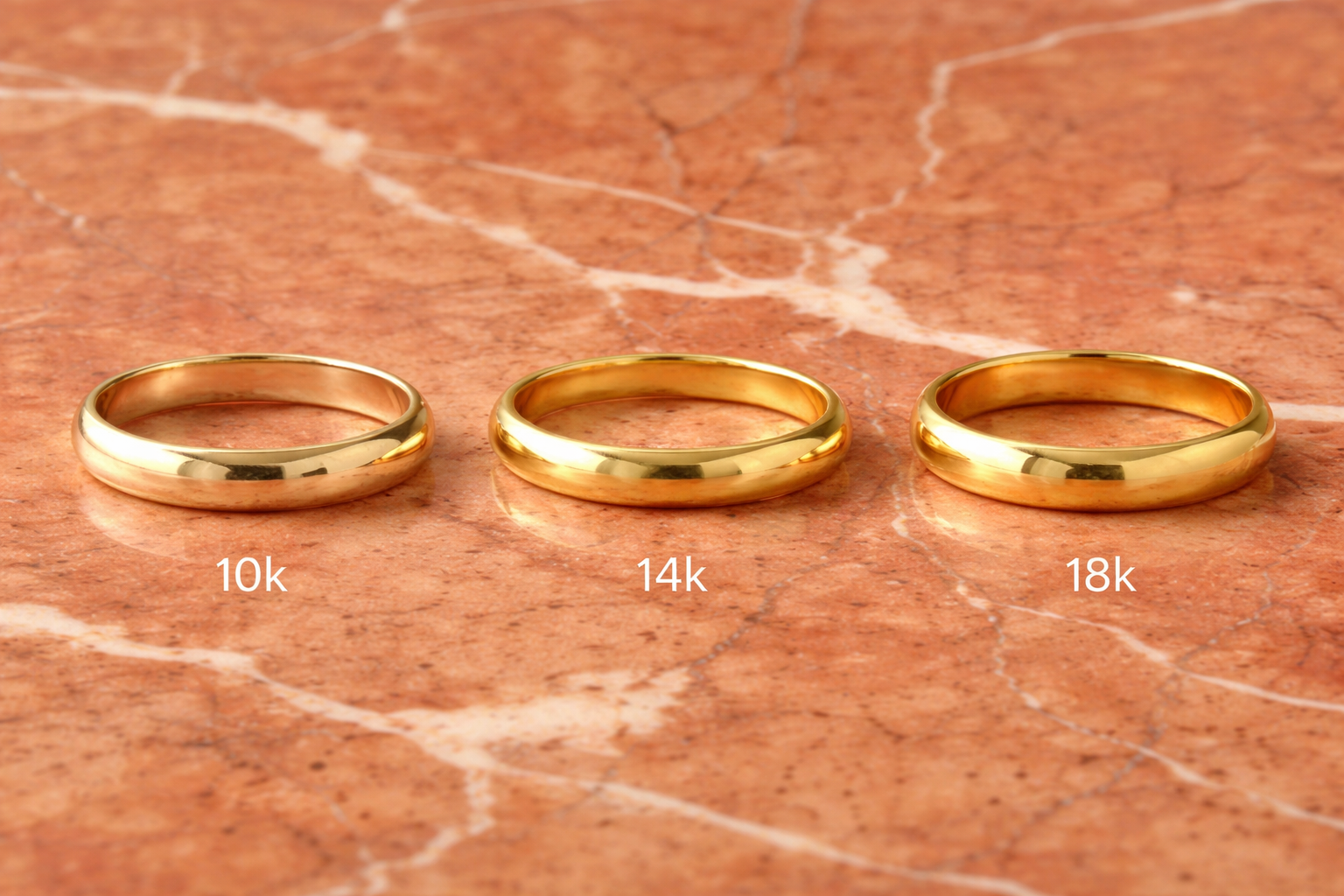
- Slightly less rich color than 18k, though the difference is subtle to most eyes and only apparent side by side
- Tarnishes far less than 10k; the copper alloys can develop a very subtle patina over a long period, but routine cleaning keeps it looking right for decades
- 14k white gold often uses nickel as part of the whitening alloy. If you have nickel sensitivity, specify palladium-alloyed white gold when commissioning
- Resale value is moderate, lower than 18k due to its lower gold content but comfortably above 10k
For most buyers, 14k is the clear choice: durable, warm in color, and the most widely used karat for fine jewelry in the U.S.
What Is 10 Karat Gold?
10k gold is 41.7% pure gold and 58.3% alloy, the minimum purity that can be legally sold as "gold" in the United States per FTC guidelines. GIA identifies 417 as the hallmark equivalent.
Who chooses 10k gold
10k is for budget-conscious buyers who want real gold at the lowest entry price. 10k is the hardest of the common golds and the most scratch-resistant, making it appealing for pieces that will take heavy use. It's also the least expensive per gram because of the lower gold content.
Tradeoffs of 10k gold
10k has more alloy than any other common gold designation. In practice:
- Noticeably paler color than 14k or 18k; the difference is obvious when the metals are placed side by side
- Higher alloy content increases the likelihood of nickel-related skin reactions in sensitive individuals
- Not recognized as fine jewelry in most international markets; Europe typically requires at least 14k for a quality hallmark
- Rarely used for fine stone-set work, as the alloy composition affects how the metal responds during setting; most goldsmiths default to 14k or 18k for prong and pavé settings
10k works well for everyday fashion pieces or anything worn without concern for damage. For something significant, most buyers step up to at least 14k.
10k vs 14k vs 18k vs 24k Gold: Quick Comparison
| Karat | Gold content | Best for | Main tradeoff |
|---|---|---|---|
| 10k | 41.7% | Budget-conscious everyday jewelry | Paler color, less fine-jewelry feel |
| 14k | 58.3% | Daily-wear fine jewelry and engagement rings | Slightly less rich color than 18k |
| 18k | 75% | Fine jewelry, heirlooms, richer color | Softer than 14k; slightly higher cost |
| 24k | 99.9% | Bullion, ceremonial, cultural pieces | Too soft for most daily-wear rings |
What Karat Gold Is Best?
The honest answer depends on the piece and how you wear it.
Best for engagement rings
For most people, 14k or 18k is best. GIA specifically notes both as strong choices for engagement rings.
- Choose 14k for durability, everyday wearability, and slightly lower cost
- Choose 18k for richer color and the highest gold content for a daily-wear ring
If you're still deciding whether to commission a ring rather than buy ready-made, our guide to what custom jewelry is and how it works covers the full process. Once you've settled on a karat, the next decision is color — our guide to white, yellow, and rose gold walks through how each wears, what it costs to maintain, and which pairs best with your stone.
Best for wedding bands
Again, 14k or 18k. Someone very active often leans toward 14k for its hardness. Someone who prioritizes color richness or is matching an existing 18k ring often prefers 18k for consistency.
Best for pendants and earrings
Because pendants and earrings take less daily impact than rings, both 14k and 18k work very well. The choice comes down to aesthetics and budget rather than durability concerns.
Best for heirlooms and resale value
18k. Higher gold content, richer look, and the most universal quality recognition internationally. It tends to age more gracefully, and because resale value is directly tied to pure gold content per gram, 18k holds the highest value of the common jewelry karats. 14k resells at a moderate value, and 10k, though real gold, commands the lowest resale return. If the piece will be passed down or might eventually be sold, karat choice is part of that calculation.
Best for budget-conscious jewelry
10k or 14k. 14k generally feels more premium because of its higher gold content and richer color. 10k is the right call when budget is the primary driver and the piece doesn't need to carry significant sentimental weight.
Working karat into your custom piece
When you commission a custom piece, karat is one of the first material decisions, and it doesn't have to be made in isolation. At Kalakari, karat choice is part of the initial design conversation. We consider how you wear jewelry, what aesthetic you're after, whether the piece needs to match something you already own, and how the gold content affects the final price. For most engagement rings and wedding bands, we work in 14k and 18k, and we'll walk you through the tradeoffs specific to your design before anything goes into production.
If you're ready to start, drop us a note below.
Gold Price by Karat: What You're Actually Paying
The karat of your piece directly determines how much of its metal weight is pure gold, and that fraction drives the material cost. Understanding this helps you evaluate quotes and know where your money is going.
How gold pricing works
Gold is priced globally per troy ounce (1 troy oz = 31.1 grams) through the COMEX futures exchange and the World Gold Council, which tracks the daily benchmark used by most jewelers worldwide. To find the gold cost in a piece, you multiply its total metal weight by the karat's gold content percentage, then by the current spot price per gram.
For example: a 5-gram 18k ring when gold is $100/gram costs 5 × 0.75 × $100 = $375 in gold material. The same ring in 14k: 5 × 0.583 × $100 = $291.50. On a standard band, the karat difference is often a few hundred dollars in material, significant but modest relative to stone and labor in a custom piece.
Live gold price by karat
Gold spot prices update continuously. Here's what a gram of gold-alloy metal costs today at each karat level, along with a calculator so you can estimate for your own piece.
White Gold, Yellow Gold, and Rose Gold: Does Karat Apply to All?
Yes. Karat applies to all gold colors. Whether a piece is yellow, white, or rose gold, the karat number tells you the gold content. The color itself comes from the alloy composition, not the purity level. All three are available in 14k and 18k, and each has meaningful differences in how it ages, how it pairs with different diamond colors, and what maintenance it requires. We cover all of that in our white gold vs yellow gold vs rose gold guide.
Caring for Your Gold Jewelry
Gold is low-maintenance compared to most metals. The basic care routine is the same regardless of karat, but there are a few karat-specific things worth knowing.
General care (all karats)
Warm water, a small amount of dish soap, and a soft toothbrush. Rinse and dry thoroughly. Monthly cleaning is sufficient for most pieces. Remove before working with harsh chemicals or cleaning products. All gold jewelry benefits from periodic professional inspection, particularly prong settings around diamonds or other stones.
Tarnishing by karat
Yes, and the difference is meaningful. Higher alloy content means more non-gold metals (particularly copper and silver) that can react with oxygen, sweat, and perfume over time. 18k gold, at 75% pure gold, almost never shows tarnishing under normal wear. 14k is significantly more resistant than 10k and holds its color well for decades. 10k, with only 41.7% gold, may show some darkening over the years if it isn't cleaned regularly, especially in humid environments or with frequent skin contact. If you have a 10k piece that has dulled, professional cleaning typically restores it. Gold doesn't tarnish the way silver does, but the more alloy in the mix, the more attention routine cleaning deserves.
Shower, pool, and ocean
Not all water is equal. Here's how each environment affects gold jewelry:
- Shower (tap water + soap): Generally fine for 14k and 18k. Soap buildup can dull the surface over time; rinse and dry thoroughly if you wear jewelry in the shower. 10k may tarnish faster with frequent water exposure.
- Swimming pools (chlorinated water): Remove your jewelry. Chlorine is corrosive to gold alloys; it weakens the metal over time, can affect prong integrity, and accelerates surface wear. Even a few exposures compound over years.
- Ocean (salt water): Salt leaves a dulling film on gold and accelerates alloy oxidation. If your jewelry gets ocean water on it, rinse with fresh water and dry immediately. Consistent saltwater exposure will age the surface faster than indoor wear.
10k gold
The highest alloy content makes 10k the most scratch-resistant but also the most reactive to environmental exposure. Of the common jewelry karats, 10k is the most prone to tarnishing: the copper and other alloys will darken over time without regular maintenance. Consistent cleaning is especially important; higher alloy content (particularly nickel) can cause skin responses if buildup accumulates against the skin. If you own 10k gold, plan on monthly cleaning and consider more frequent attention for pieces worn daily.
14k gold
14k is forgiving and durable under daily wear. It tarnishes far less than 10k, doesn't require special storage, and holds its appearance well for decades with standard cleaning. If you've chosen a white gold finish, rhodium plating may need renewal every one to two years depending on wear frequency.
18k gold
18k's higher gold content makes it the most tarnish-resistant and the least reactive to skin and environment. Surface micro-scratches do develop more visibly over time under heavy daily use; occasional professional polishing restores a like-new surface. Given 18k's value, periodic professional inspection is especially worthwhile for pieces worn daily.
Frequently Asked Questions
24k is the highest karat of gold and represents 99.9% pure gold. It has the richest, most saturated yellow color of any gold alloy. For most everyday jewelry and fine jewelry applications, however, it's too soft to hold its form; prongs would bend and the metal would deform with regular wear.
Yes, fully and unambiguously real. The FTC requires gold jewelry to be marked with its karat quality, and 14k is one of the most common designations in the U.S. fine jewelry market. It contains 58.3% pure gold, with the balance made up of alloy metals that improve hardness and durability. Higher alloy content doesn't make it less genuine; it makes it more wearable.
18k gold is 75% pure gold and 25% alloy metals. It carries the hallmark 750 in European notation. It's the international standard for fine jewelry and the default choice for most high-end designers and luxury brands. The high gold content gives 18k a noticeably richer, warmer color than 14k, particularly in yellow gold.
24k gold is pure gold: 99.9% gold content with no meaningful alloy. It has the deepest, most saturated yellow color of any gold and carries the highest intrinsic value. It's used for gold bullion, investment pieces, and ceremonial jewelry in South Asian and East Asian traditions where purity carries both cultural and financial significance. For most daily-wear fine jewelry, it's too soft.
10k gold is 41.7% pure gold and 58.3% alloy, the minimum purity that can be legally sold as gold in the United States per FTC guidelines. It's the hardest and most scratch-resistant of the common karats, and the most affordable per gram. The tradeoff is a noticeably paler color than 14k or 18k, and higher alloy content that can increase the likelihood of nickel-related skin reactions.
Not the way silver tarnishes. Gold itself is highly oxidation-resistant. The copper alloys in 14k can create a very subtle patina over a long period, but this is meaningfully different from the blackening silver experiences. With normal wear and occasional cleaning (warm soapy water and a soft brush), 14k gold holds up well for decades without special storage or treatment.
Both are excellent choices and both are recommended by GIA for engagement rings. 18k offers richer color and higher purity; 14k offers greater hardness and durability at a slightly lower cost. For most people, the decision comes down to aesthetics: if a deep, warm yellow gold matters to you, 18k delivers it more fully. If you work with your hands or want the most durable option, 14k is the stronger choice.
750 is the European hallmark for 18k gold, meaning 75% gold content. This decimal notation is standard across Europe and much of the international market. Similarly, 585 equals 14k (58.5% gold), and 417 equals 10k (41.7% gold). If you see these numbers stamped on a piece, they carry exactly the same information as the karat designation, just in a different format.
Yes. 10k gold is 41.7% pure gold, which meets the FTC's minimum threshold to be legally sold as gold in the United States. It's fully genuine gold with a higher alloy content than 14k or 18k, which makes it harder and more affordable but noticeably paler in color.
14k or 18k. 14k is the more common choice for everyday wear because its higher alloy content makes it harder and more scratch-resistant. For most people who wear their jewelry daily, including engagement rings and wedding bands, 14k is the practical default. 18k is also suitable for daily wear and accumulates micro-scratches at only a slightly faster rate, which most people don't notice in practice.
18k, or palladium-alloyed 14k white gold. The primary irritant in gold alloys is nickel, which is used in some white gold formulations and becomes more concentrated at lower karats. 18k has less alloy overall, meaning less potential nickel exposure. If you have nickel sensitivity and prefer 14k, specify palladium-alloyed white gold when commissioning your piece.
For most fine jewelry, yes. 18k gold offers the highest gold content suitable for daily-wear rings, the richest yellow color of any wearable karat, and the best resale value of the common jewelry standards. The material cost premium over 14k is typically a few hundred dollars on a standard band. For heirloom pieces or anything where color and purity are priorities, 18k is the standard most high-end jewelers default to without hesitation.
All gold is highly resistant to tarnishing, but higher karat gold is more resistant. 18k, with 75% pure gold, almost never shows tarnishing under normal wear. 14k is significantly more resistant than 10k. 10k, with its higher alloy content (particularly copper), can show some darkening over time without regular cleaning. None tarnish the way silver does. Routine cleaning with warm water and a soft brush keeps any karat looking its best.